The Endtimes Trilogy
 The End is Nigh
If art imitates life¸ it's only natural for apocalyptic inspiration to work its way into my game design practice. I do my best to keep my hope for a better world alive¸ but there's no pretending that we're not living through the end of the world. Or really¸ the end of many worlds. Don't misunderstand me¸ though: I don't mean to say that the globe is exploding in nuclear hellfire¸ or that aliens are about to invade¸ or that supervolcanoes are going to erupt and erase all humankind.
Rather¸ the end of the world as understood by The Endtimes Trilogy is but one apocalypse in a long¸ historical process that constantly sees worlds of any size end and begin anew. These games interrogate what it means for the world to end and what we should be doing about it. Should we ignore it and try to continue life with the status quo¸ like the characters in Quy Serra Serra? Should we allow the endtimes to seep into our brains and further atomize us into individual action like the warden of the bunker in Into A Warm Sun? Or should we grapple with our déjà vu and recognize the pattern of history like the players in The Way Out?
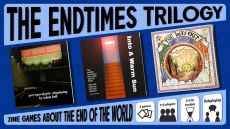
The Endtimes Trilogy is a set of three brand new tabletop roleplaying games about the end of the world. Each one comes as a 30-or-so page square 5.5" zine with the complete rules for a standalone¸ single-session game. Play them seperately¸ or combine the three games into a short campaign where the same characters live through each game's different take on the apocalypse.
Quy Serra Serra
Roleplay four shared characters going about their unsavory lives as they try to ignore that the world is collapsing around them. Gameplay is simple: on your turn¸ you'll decide whether to set a scene or introduce a new character. When it's your turn¸ you get to act as the GM for that scene or character's introduction¸ and everyone else will play a supporting role.
The game takes place across three acts. The main difference between acts is how you interact with facets. These are things that stand out to you in the story - a side character¸ an important heirloom¸ an idea¸ the yellow mud or spiderwebs that unnaturally coat everything in the scene¸ that kind of stuff.
- In the game's first act¸ you'll create a bunch of facets after your scene concludes.
- In the second act¸ the end of the world commences. You'll instead be destroying facets on the table based on what's happening in the world around the characters. If a main character ever loses all of their facets¸ they get swept up in the madness.
- In the third act¸ you'll sort the facets based on what was destroyed¸ what went missing¸ and what somehow survived through the wreckage.
Into A Warm Sun
Live out your life in a bunker owned and operated by the warden¸ a prepper vindicated by some great earth-shaking calamity. You're incredibly lucky that they had the foresight to put all this together and save your life. Show some gratitude.
One player plays as the warden. They're the GM of this game¸ so they're in charge of setting scenes¸ describing the environment¸ and controlling the pacing of the story. They also play the warden in the fiction¸ so they're in charge of the bunker¸ the food¸ the entertainment¸ the sleeping arrangements¸ and everything else.
The other players¸ the tenants¸ are along for the ride. When they inevitably disagree with the warden¸ either in character about something the warden says or does or out of character about the pacing of the story or an event that happens¸ they can demand the warden roll dice to retain control of that moment of the narrative. What follows is a huge gamble played out using a dice game inspired heavily by Cee-lo. If the warden wins¸ they'll gain control¸ trust¸ or truth. If they lose¸ the tenants will inch towards freedom¸ doubt¸ or a slow reveal that the warden has been telling lies.
The Way Out
Take on the role of a coterie of characters with a unique burden: no matter where they appear in time and space¸ the world seems to be on the verge of coming to an end. When it does¸ their story continues elsewhere for however long it takes until that elsewhere meets its doom as well. Our concern lies not with how they transition between these times and how much they remember of their previous lives¸ but rather with their moment-to-moment experience in the lead-up to the end of that world.
Each chapter tells one of these stories using a talon of tarot cards. Each chapter will be fully played out by all players on equal footing; there's no GM here. Instead¸ everyone must roleplay in character at all times. They can describe the world around them and invent new truths about the world¸ but must do so from the perspective of their character sight¸ hearing¸ touch¸ smell¸ taste¸ knowledge¸ and intuition. If that's too restrictive¸ fear not. The game's moves help expand your narrative power¸ allowing you to embody other characters for a time¸ narrate out of character¸ cut the scene¸ remain silent¸ experience deja vu¸ and more.
Each move slides one of the tarot cards to the center of the talon in numerical order. If you move a major arcana¸ the Bringer arrives and complicates things for the coterie. If there's nothing to slide¸ you start the count again and begin the end of the world. Once all cards are played¸ that world ends. A new chapter begins with the same characters manifested in a different place and time to repeat the cycle¸ again and again.