Pencilquest
 |
What is it?
Pencilquest is a tactical dungeon-crawl. It's solo and print-and-play. You'll select a party of 2¸ 3 or 4 heroes¸ equip them with potent abilities¸ and guide them through a dungeon filled with vicious monsters.
You crawl dungeons with a pencil?
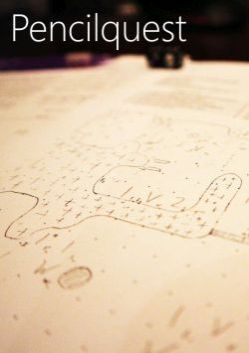
Yep! Like my other games¸ it pushes the envelope on what can be simulated with paper and marks on it. Pencilquest is my take on dungeon-crawling. It's all-in on the medium - you draw your dudes¸ draw the monsters¸ and erase things as they die (and move).
So what's the game like?
The gameplay is tactical¸ grid-based combat. You plan and execute deadly combos¸ react effectively to elite rolls¸ and carefully shepherd your limited Vim pool until you reach the next Fountain¸ which restores all your heroes.
Those heroes have strong¸ role-defining class identities¸ which gives it a bit of an old-school MMO feeling - you want the Warrior taking most of the hits¸ the Priest heals well but does little else¸ and you're quite likely to wipe if the Rogue takes aggro.
The end of each map has an exceptionally difficult challenge which will require careful planning and skilful execution to overcome.
Each map has a push-your-luck style choice to make¸ in the form of Heroic Feats¸ which change how the map must be approached¸ and grant you additional success bonuses if completed.
As you unlock more hero abilities¸ you'll discover completely new approaches to the various challenges the maps offer. Building clever hero-ability compositions¸ and tailoring them to each map¸ is a kind of 'deck-building' meta-game on top of the tactical dungeon-crawling.
Show me the dungeons!
While simplifying a dungeon down to rooms (as opposed to tiles) is a great way to slash complexity¸ you lose out on the tactical puzzle of positioning your units. I really like the "where do I put my dudes?" puzzle¸ so Pencilquest sticks to the grid.
The systems work hard to keep full grid-based gameplay from slowing things down. They're so tight that a deep game is baked into extremely simple representations: two-stroke symbols for heroes¸ and numbers or single letters for monsters.
The maps are also filled with a modest spread of RPG-ish interactables: fountains¸ doors¸ levers¸ traps¸ and so on.
Your brave/foolish adventurers
Each hero has a unique¸ Chess-like movement pattern. This makes traversing each part of the map a spatial puzzle¸ beyond having to get rid of the bad dudes in the way.
Abilities are your heroes' bread and butter. They mostly hurt monsters or help allies. They might cost nothing but the action spent to use them¸ or they could draw on your heroes' Vim (which is also what they lose when their blood is spilled). Very powerful abilities also draw on the extremely limited Nerve pool.
The easy route to balanced heroes which feel distinct is keeping customization really light. This comes at the cost of the player's creative expression¸ so I found it unacceptable.
I gave each hero a unique list of wildly varying abilities. From these¸ you select a handful to "equip" on each adventure. This means that you get to meaningfully character-build each time you play.
Hmm¸ what if I run the Rogue without Backstab¸ but with both Longbow and Shortbow? This gives her strong flexibility at range¸ but lowers her overall damage output a bit.
A given hero can play fairly differently from run to run¸ depending on how you change their abilities up¸ but class identity is preserved¸ as heroes' ability pools are designed around a flavour. Rogues have mobility and melee¸ single-target damage; Warriors have mitigation and melee¸ multi-target damage.
Finally¸ since you're building a party¸ you can exploit synerg