SAKE (Sorcerers¸ Adventurers¸ Kings¸ and Economics) Basic Edition (2e)
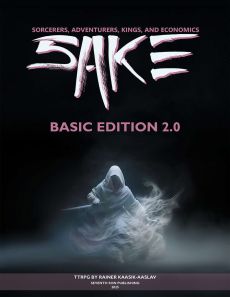 |
The Basic Edition 2.0 is a simplified version of the SAKE Full Rulebook. It provides the rules for experiencing the core aspects of the game¸ including domain building and management¸ dungeon crawling¸ wilderness adventuring¸ chases¸ and combat. It also features rules for magic¸ exploring the Otherworld¸ and forging pacts with gods to channel their spells. Together with the free "Daimyo of Storkway” domain and adventure scenario¸ the book provides enough content for a quite lengthy campaign.
SAKE (Sorcerers¸ Adventurers¸ Kings¸ and Economics)
SAKE (Sorcerers¸ Adventurers¸ Kings¸ and Economics) is a traditional tabletop roleplaying game with a touch of strategy game. It is a crunchy¸ modular¸ d20 point-buy game set in an early-modern fantasy world¸ with detailed systems for domain-building and overseas trading.
Core Mechanics
- SAKE uses the standard 7-dice set(d4¸ d6¸ d8¸ d10¸ d%¸ d12¸ d20).
- Most rolls are made with a d20 (skill checks¸ Attack rolls¸ spell rolls¸ etc.).
- SAKE is a point-buy system. During play¸ PCs earn Experience Points (EXP)¸ which they can use to purchase Skill Ranks¸ abilities¸ Health Points (HP)¸ spells¸ and more.
- EXP is gained through events and based on the personality traits of the Player Character (PC). At the end of each session¸ the Game Master (GM) and players evaluate how much EXP was earned individually.
- Hex crawls and dungeon crawls are divided into Turns. Each PC gets one Action per Turn.
- The PCs' combined skills and abilities determine the group's overall capabilities¸ from which Opportunities and Hazards arise. These are rolled using a d100 (percentile dice).
- Encounters depend on the PCs' Actions or the results of Opportunity and Hazard rolls.
- To prepare¸ the GM uses dungeon or region sheets. These sheets are partly pre-filled¸ speeding up and simplifying preparation work.
- Combat is divided into 10-second Combat Rounds¸ where each character has one Action and one Reaction.
- The Order of Actions is determined at the start of combat.
- Actions are used for movement¸ spells¸ attacks¸ etc.
- Reactions are used during an opponent's Action to disrupt them (e.g.¸ shooting while an opponent moves).
- Attack and Parrying are resolved by opposing rolls.
- Armour provides Damage Reduction (DR)¸ subtracted from Damage dealt.
- In chase situations¸ distance isn't measured in meters or time in Rounds. Instead¸ the fleeing character must accumulate 5 Escape Points. They can attack with ranged weapons or avoid being hit by sacrificing Escape Points.
- Persuasion. PCs can attempt to persuade NPCs to do something¸ change their opinion¸ or believe something. If the GM deems the NPC unwilling but influenceable¸ they set static Difficulty Levels (DL) based on the reasons for their reluctance. PCs can overcome these by taking certain actions or arguing their case. Arguing uses different skills depending on the subject - e.g.¸ Theology for matters of faith; Social Skills can always be used.
- Magic is treated like other skills. PCs can advance their mastery of schools of sorcery (skills) by acquiring Ranks.
- Spells are individual abilities that must be obtained separately.
The core mechanics are similar across all modules. For example¸ the percentile rolls for Opportunities and Hazards during dungeon exploration are similar to Prosperity¸ Discontent¸ and Corruption percentages used in domain play. Just as individual characters have Actions and Reactions in combat¸ military units also have Actions and Reactions in large-scale battles. Escape mechanics apply similarly¸ whether it's characters¸ armies¸ or ships fleeing.
As SAKE is modular¸ it's easy to focus on only the necessary parts¸ preventing the game from overwhelming players. If you prefer classic dungeon crawling¸ you don't need to worry about world economics or domain management. On the other hand¸ you can play SAKE as a domain strategy game¸ using the random events system in the Domain and Warfare module to generate the adventure¸ operating by Domain Turns¸ and only engaging in army-scale battles when launching campaigns against neighbouring kingdoms - never needing to fight hand-to-hand.